Last updated on September 8th, 2026

The healthcare industry has experienced a remarkable transformation over the last five years. Driven by technological advancements, the post-pandemic patient expectations drastically differ from what they used to be.
In this rapidly evolving time, the strategies that worked for your healthcare practice or organization yesterday may not guarantee success today. Staying ahead means understanding the latest trends in healthcare marketing.
In this blog post, we’ll explore the most lucrative trends in healthcare marketing, helping you navigate these changes and create strategies that not only reach your audience but also position your organization for long-term growth.
What are some important trends in healthcare generally?

In healthcare, emerging trends point toward changing patient behavior, industry innovations, and market dynamics. Staying updated on trends ensures that your marketing efforts remain impactful and aligned with current patient expectations. So, here are some trends that you should know of:
Telehealth is booming
Telehealth use grew quickly during the COVID-19 pandemic. Telehealth is expected to grow at a compound annual growth rate of 24% from 2023 to 2030.
As a result of this, remote consultations have become mainstream. Patients now expect to connect with healthcare providers from the comfort of their homes. They even have access to apps, wearable technology, and secure video conferencing platforms to enable these consultations.
With more patients turning to virtual care, healthcare marketers must shift their strategies to emphasize and accommodate accessibility, convenience, and digital innovation.
The most obvious way to do this is by highlighting telehealth services in campaigns to attract tech-savvy patients who value remote care options. However, other strategies can be integrated, too, which we’ll discuss below.
Staffing shortages increase wait times
Healthcare staffing shortages have reached critical levels, with projections showing a deficit of 87,150 primary care physicians by 2037. The industry has always needed more specialized staffing, and the COVID-19 pandemic severely exacerbated this issue.
Frontline workers faced burnout, illness, and early retirement. Long hours and high stress experienced by doctors and frontline workers even deterred aspiring doctors, who began gravitating toward fields offering better work-life balance. This strain has left many healthcare facilities under-resourced, leading to longer patient wait times and delayed treatments.
For healthcare marketers, this challenge presents both obstacles and opportunities. On the one hand, marketers need to come up with transparent and creative ways to help patients navigate waiting times. On the other hand, they also need to bolster the healthcare organization’s brand to support recruitment efforts.
Cybersecurity is essential
As the healthcare industry increasingly relies on digital systems, ensuring cybersecurity should be your organization’s top priority. Cyberattacks, such as the UnitedHealth-owned Change Healthcare ransomware breach in 2024, demonstrate the devastating impact of data breaches. This attack disrupted insurance claim processing and exposed sensitive patient information, affecting millions.
Even so, digitization in the healthcare industry shows no signs of slowing down. With sensitive patient information stored in electronic health records (EHRs) and the rapid adoption of Internet of Things (IoT) devices, the risk of cyberattacks just keeps growing.
This is why healthcare organizations are now investing heavily in cybersecurity measures, such as data encryption, multi-factor authentication, and employee training on phishing and malware risks.
This also falls in line with complying with regulations like HIPAA (in the U.S.) and GDPR (in Europe), which are also becoming more stringent, prompting organizations to prioritize data security.
Healthcare marketing trends in 2025 you should know
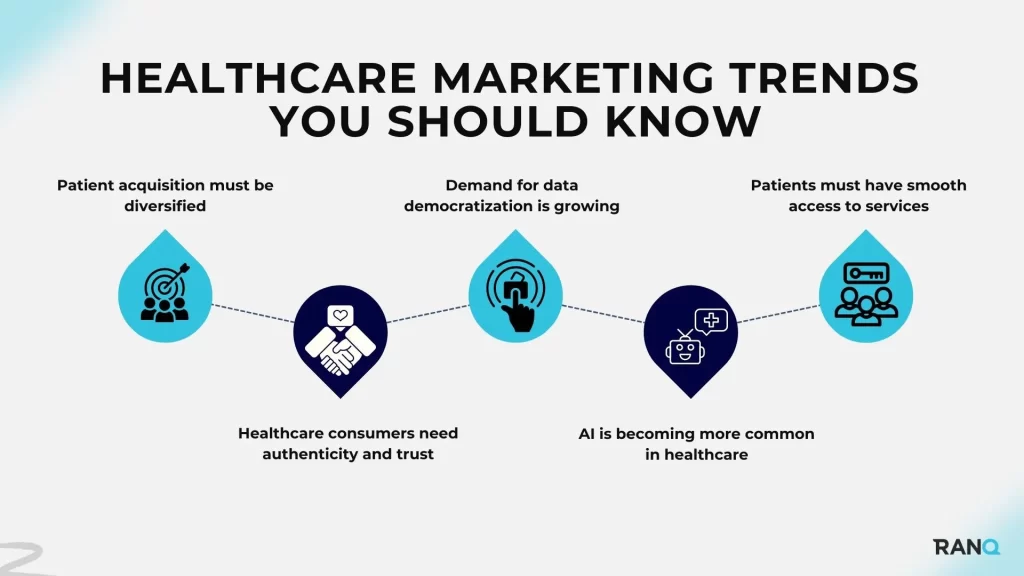
Healthcare marketers are at a crossroads. At the bare minimum, your marketing strategy needs to be informed by the changing patient behaviors. Further, it should also directly address the threats and complications of operating in a highly digitized environment. Here are some marketing considerations that address those aspects:
Patient acquisition must be diversified
Patients use technology to find and compare providers. Your marketing can reach them through several channels, including search, referrals, and advertising.
A multi-channel approach uses many digital platforms, social media, content marketing, and personalized outreach to meet patients where they are. The channels you begin with largely depend on your patient’s demographic.
Younger patients might favor social media and online scheduling, while older patients may prefer traditional referrals or direct communication. To diversify efficiently, you can also start by strengthening your online presence with SEO-optimized content with targeted PPC campaigns and then lean into social media platforms to engage patients.
Healthcare consumers need authenticity and trust
Whether exacerbated by misinformation during the COVID-19 pandemic, the data breaches that followed, or concerns over profit-driven practices, patient trust in healthcare systems has been steadily declining. This makes authenticity and trust more critical than ever in healthcare marketing.
Patients want honesty in communication and genuine care, not just transactional relationships. This is why marketers must now also include transparency, empathy, and patient-centeredness in marketing messages. Here are a few ways to do that:
- Show genuine care: Highlight your healthcare organization’s or practice’s commitment to patient safety, data protection, and ethical practices.
- Humanize your brand: Share patient testimonials, showcase real outcomes, and offer behind-the-scenes looks at medical teams.
- Focus on authenticity: Customize messages to appeal to a diverse audience, reflecting cultural sensitivities and inclusivity.
Demand for data democratization is growing
The digitization of healthcare has generated vast amounts of patient and healthcare operational data, from electronic health records (EHRs) to telehealth platforms. Simultaneously, healthcare consumers or patients now expect personalized care and communication after being exposed to personalized marketing from other industries.
To meet patient expectations, marketing teams must start relying on data-driven strategies to understand patient behavior, improve engagement, and measure campaign effectiveness.
Integrating data democratization into healthcare marketing gives teams access to analytics tools and platforms. They can interpret data and make decisions with less dependence on IT or data specialists. Here are some examples:
- Personalized patient outreach: Patient data is used to deliver personalized email campaigns, such as appointment reminders or wellness tips.
- Campaign performance analysis: Marketing teams access real-time data dashboards to monitor performance and ROI, allowing for quick adjustments.
- Community health initiatives: Data insights help identify underserved populations for campaigns like vaccination drives or health screenings.
- Telehealth promotion: Marketers analyze usage patterns to create customized campaigns promoting telehealth services to specific demographics.
- Patient feedback integration: By democratizing survey data, teams can improve patient experience and refine communication channels.
AI is becoming more common in healthcare

AI is already being used to improve patient care and operational efficiency in healthcare. It’s helping early detection by analyzing medical imaging with high accuracy. It’s enhancing predictive analytics to identify at-risk patients, enabling preventive care. It also personalizes treatments by analyzing genetic data to tailor therapies.
It’s inevitable that it’ll find its way into marketing as well, especially because marketing holds the potential to drive positive patient outcomes. For healthcare marketers, AI offers unmatched opportunities to improve campaign strategies. Here are a few ideas to integrate AI into your healthcare marketing mix:
- Use AI-powered chatbots to provide instant patient engagement, answer queries, and schedule appointments.
- Use predictive analytics to help optimize ad targeting and campaign timing.
- Rely on sentiment analysis tools to monitor patient feedback and guide adjustments to messaging.
- Automate repetitive tasks like email sequencing, freeing marketers to focus on strategy.
AI tools can help healthcare marketing teams analyze data and complete routine tasks more efficiently.
Patients must have smooth access to services
Patients want convenient appointments and a way to contact their provider through their preferred channels. In fact, 71% of people cite access as a top factor in selecting a new provider, according to Accenture’s 2021 Health and Life Sciences Global Experience Survey.
Healthcare marketers can highlight the need for accessible tools such as patient portals, telehealth services, and mobile apps.
On those platforms offer features like online scheduling, real-time chat support, and digital payment options. Another way is to strategically look at and address any accessibility barriers that patients may have engaging with your services, whether on the ground, telephonic, website, or app platform.
Integrating these services into marketing strategies can attract patients seeking convenience and efficiency. Of course, what really makes a difference is communicating with authenticity and credibility, and that is a non-negotiable in healthcare marketing.
Invest in authenticity and credibility in healthcare marketing with Ranq
AI, data analytics, and telehealth platforms give healthcare marketers more ways to understand patient needs and reach their audiences.
However, these innovations are only effective if your marketing reflects authenticity and credibility. Patients trust brands that demonstrate transparency, genuine care, and ethical practices.
At Ranq, we help you build trust by creating end-to-end SEO and internet marketing campaigns rooted in integrity. This ensures that your messaging aligns with your brand values. If you want to invest in authenticity and credibility, reach out, and we’ll take it from there.