Last updated on October 21st, 2026

When marketing a SaaS product, there’s constant tension because you’re often trying to balance contrasting goals.
Should you focus on customer acquisition or customer education and retention? Do you take the targeted marketing approach to boost conversion rate or choose to broaden your market while settling for a slightly lower conversion? Immediate lead generation is tempting, but you know that long-term brand building is essential to making a mark in the market.
SEO and PPC can complement each other, but your SaaS business does not have to use both. Compare each channel against your audience, budget, sales cycle, and the outcomes you can measure.
An effective SaaS marketing strategy can use PPC for immediate traffic and SEO for longer-term growth. Here is how to combine them.
Understanding SEO vs. PPC for SaaS marketing strategies

Here are a few things to understand if you’re trying to decide between SEO and PPC for your SaaS marketing strategy:
What is SEO marketing for SaaS?
SEO marketing for SaaS involves using specialized techniques to gain more visibility on the Search Engine Results Page (SERPs). When your SaaS website shows up higher in the SERPs, you receive more website traffic and increase customer acquisition.
SEO involves multiple strategies like keyword optimization, on-page content optimization, technical SEO, or even link-building. If your Saas website is new, initiating your SEO efforts by fixing common technical SEO is a smart move.
For slightly more advanced websites that publish high-quality content regularly, content optimization becomes crucial. Finally, when you’ve put in place a well-thought-out SaaS content marketing strategy, you can look into backlinking to gain authority.
What is PPC marketing for SaaS?
PPC (Pay-Per-Click) marketing for SaaS involves creating paid advertising campaigns to direct traffic to your website. In a campaign, you bid on specific keywords that are highly relevant to your SaaS offering and pay when a user clicks on the ad.
Paid campaigns can reach people soon after launch, but an ad click is not a conversion. Test the audience, message, landing page, and next step, then assess lead quality and customer acquisition cost.
By combining PPC with persuasive ad copy and landing page content while regularly adjusting bids, marketers can maximize ROI for SaaS companies while accelerating new customer acquisition.
Which is better for SaaS: PPC or SEO?

PPC and SEO are separate marketing approaches catering to different goals and objectives. PPC marketing is ideal for generating fast results, making it perfect for launching new SaaS products, time-sensitive promotions, or entering highly competitive markets. Also, PPC campaigns are really effective at retargeting customers.
SEO can support organic discovery over time, but it requires investment in content, implementation, and maintenance. Whether it is more cost-effective than PPC depends on the results and costs of each channel for your business.
SaaS companies can use PPC and SEO together. PPC brings in immediate traffic, while SEO builds organic visibility over time.
Below, we’ll show you how to do this, but before that, it’s critical to understand that SaaS marketing is unique, which is why it benefits from using both SEO and PPC.
Benefits of using both SEO and PPC in SaaS
You know the benefits of SEO and what PPC w.r.t. a SaaS marketing strategy. What’s important to understand is that when used cohesively, these strategies can bring results that turn out to be more than the sum of their parts.
Here’s how: If you simply used PPC, you’d get immediate visibility and traffic. However, pay-per-click marketing campaigns reveal valuable data for testing keywords, refining messaging, and driving quick conversions.
This means that if you also have ongoing SEO campaigns, your PPC campaigns can inform your SEO campaigns, helping to target high-converting keywords faster.
Conversely, your SEO campaign can lay the groundwork for sustainable success by building brand authority and driving traffic over time. This organic traffic can lower your overall cost of PPC by improving quality scores in search engine algorithms, leading to better ad placements at lower bids.
In this way, by aligning PPC and SEO, you can use the strengths of both PPC for short-term wins and SEO for long-term gains. But how do you create a cohesive, collaborative strategy that capitalizes on the strengths of both PPC and SEO? Here’s how:
How to combine SEO and PPC for your SaaS marketing strategy
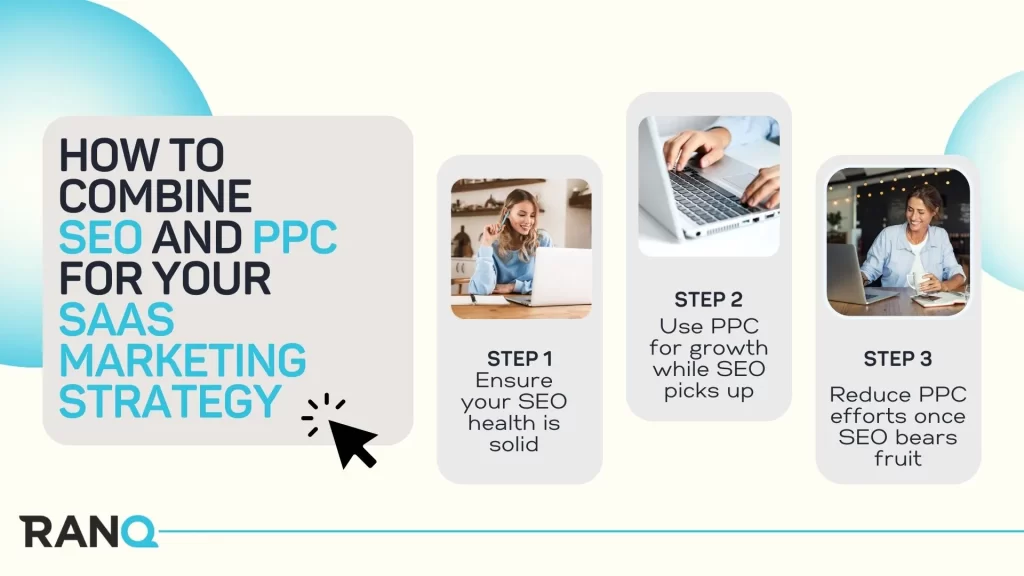
So, it’s clear that SEO and PPC together can get the best results for your SaaS company. However, you do have to be intentional about how you overlay them. We combine these strategies in three steps or stages to create mutually reinforcing marketing outcomes for our clients:
Step 1: Ensure your SEO health is solid
Imagine you have a store in a mall. Would you start an ad for your store if you’re not ready to sell your product? What happens if potential customers enter a store that’s still being finished? If the sales process is bumpy and rough around the edges, they leave with an unfavorable impression of your store.
Your website is your online store, so start by ensuring you’re ready to attract potential visitors. This means optimizing your website with technical SEO. In practical terms, this means optimizing your site’s structure, content, and user experience. Making it faster, if need be, and making it easier to browse and navigate.
So that when you start receiving traffic, which you will thanks to PPC marketing, your website will be able to use it for conversion. What’s the point of pulling a customer with a PPC ad only to have them bounce because your website was 1 second slower to load or they were faced with a 404 error message?
All this means is that giving your SaaS website a good technical foundation is essential. You can start by auditing your website’s technical health. This can be done with the help of SEO auditing tools, or you can simply use our free SEO audit tool. The groundwork you do here will enhance the efficacy of your next step. That’s phase 1. Done.
Step 2: Use PPC for growth while SEO picks up
Once your foundational SEO is in place, it’s time to use PPC in your SaaS marketing strategy for immediate growth. Conduct keyword research to identify terms that your target audience is searching for. Set a budget that aligns with your goals and choose a bidding strategy that suits your objectives.
While all this is happening, you have to keep up your SEO efforts going. This means regularly publishing high-quality SEO-optimized content that informs, educates, and meets users at different stages of their buying journey.
This is because SaaS sales cycles are long, and the intangible nature of SaaS products demands that content fills the gaps in the target audience’s psyche. This is also why SEO content for SaaS is unique, it has to fulfill the dual purpose of education and persuasion. Enlisting the services of a good content marketing agency at this stage can help.
Working with experts at this stage is also important, as they can help you use PPC keyword data for the success of your SEO efforts. Experts can help you refine keyword selection for your content marketing, split test landing pages/ad copies, and even use PPC to promote your content.
Conversely, PPC can fill the gaps where your SEO campaign might be slow or where competition is fierce. A strong PPC campaign will keep your SaaS product visible and top of the customer’s mind. You can continue capturing market share while your organic rankings gradually improve and SEO gains traction over time.
In phase 2, coordinate your PPC and SEO campaigns so each can inform the other.
Step 3: Reassess the channel mix using results
When organic traffic begins contributing to qualified leads or customers, reassess your channel mix. Compare incremental results and acquisition costs before deciding to reduce, maintain, or increase PPC spending.
You’re not abandoning PPC altogether. Instead, you’re reallocating resources to areas where they can have the most impact and also targeting and narrowing your PPC campaigns to maximize ROIs.
For example, once you have steady organic traffic, you can focus your PPC efforts on more targeted campaigns, such as remarketing, promoting new features, or reaching highly specific audience segments.
Ranking organically for a keyword is a reason to test paid coverage, not an automatic reason to stop it. Compare the effect on total qualified leads and sales while accounting for seasonality, branded searches, and changes in demand.
Keep testing as your audience, offer, and competition change. Use the evidence from earlier campaigns to form better hypotheses, then check whether those assumptions still hold.
The budget freed up from reduced PPC spend can be reinvested into further optimizing your SEO strategy, such as expanding content or improving site performance. That is if you want to maintain the same marketing budget.
If you want, you can also reallocate to product enhancement, UX development, post-sales support, management, or any other aspect of running a SaaS business. The possibilities are endless when you have the budget!
Need help improving your SaaS marketing strategy? Ranq knows how
Coordinating SEO and PPC can help a team share research and evaluate its channel mix. Decide which work to handle internally and where outside support would add useful expertise or capacity.
Ranq can help assess how content, search visibility, and conversion paths fit your SaaS acquisition goals. Tell us about your product and current channels to discuss priorities, responsibilities, and how progress would be measured.