Last updated on October 21st, 2026

A featured snippet can make an answer prominent in Google Search, but there is no special markup or guaranteed formula for obtaining one. Start by answering a real audience question clearly.
If you want to become Google’s chosen one for a featured snippet, you’ve come to the right place. Getting a Google featured snippet can be an extremely effective way to increase visibility and boost the authority of your brand or business.
Google chooses whether to show a featured snippet for a particular search. A useful answer may be eligible without ever being selected, and selection can change over time. Measure the result rather than promising a “position zero” outcome.
Let’s break down how to get a featured snippet on Google and what that might mean for your website.
What is a Google featured snippet?
Featured snippet meaning
A featured snippet presents an extract from a page in a format that leads with the answer and identifies its source. Google explains the format in its featured-snippet documentation. Featured snippets and AI-generated search answers are different features.
Older studies of featured snippets describe the search results they sampled at the time. They do not establish a current rule that a page must already rank in the top ten, or a percentage that applies to every query and market.
Review the live results for your audience’s question and compare them with your own search performance. Our keyword-finding guide explains how to distinguish reported queries, tool estimates, and words found on a page.
Featured snippet example
There are many types of featured snippets, like short paragraphs, numbered lists, bulleted lists, tables, etc. What remains true across all types is that they’re geared toward providing a user with the most immediate and concise answer to their question.
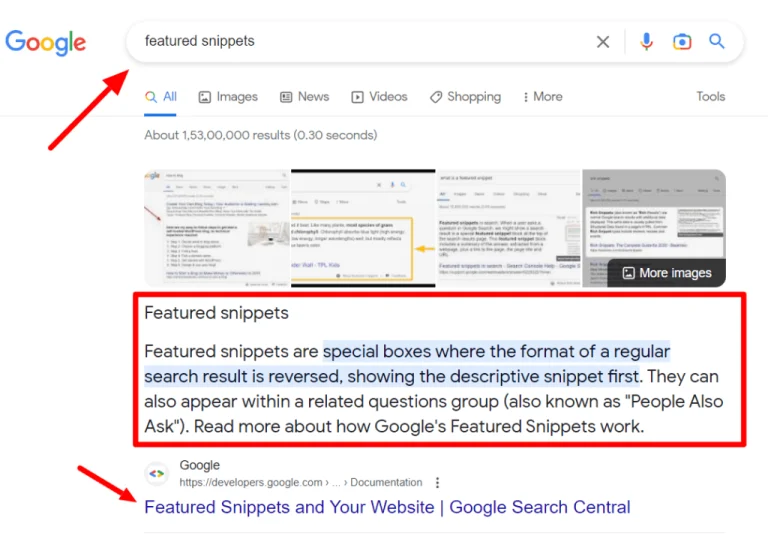
Above is a featured snippet example for the search query “featured snippets.” Below the explanation, you can see the link to the Google support page that this is pulled from.
Benefits of featured snippets in SEO
A featured snippet can increase the prominence of an answer. Its value still depends on the query, the people who see it, and whether they need to visit the source page.
- Brand visibility: a prominent answer can expose your business to relevant searchers. The screen space it occupies varies with the query, device, and other result features.
- Source recognition: the result identifies the source of the answer. Selection does not automatically increase a third-party domain-authority score or guarantee more traffic.
You’d think being above position 1 in the SERPs for a keyword would mean optimal traffic, too. Unfortunately, things aren’t so cut and dry with featured snippets when it comes to traffic and click-through rates (CTRs).
Some searches can be answered within the results page. A snippet may therefore change clicks differently from impressions. Compare the same page and query over a meaningful period, allowing for other search-result changes.
There is no universal click share or guaranteed traffic gain from a featured snippet. Check your own impressions, clicks, and relevant downstream actions before deciding whether the change helped.
Treat a featured snippet as one possible search presentation. A page should remain useful when that feature does not appear or another source is selected.

How to optimize for featured snippets on your website
Find the featured snippets you might already have
Use current search results and any available SERP-feature filters in your SEO tool to identify questions where a featured snippet appears. Start with relevant existing pages that already answer those questions and have search visibility.
Record the current answer and performance before changing a page. Keep accurate, useful passages, and update them when facts, examples, or the reader’s needs change.
Why should you find featured snippets that you already have, then? Because finding featured snippets in your existing content will lay the groundwork for the following two tips: optimizing your best-ranking content and creating new content.
Use your best-ranking content
Existing pages with relevant search visibility can be a useful starting point because you already have an answer and a performance baseline to review.
Search the question in the relevant market and inspect the answer format shown. Improve your page where the reader needs a clearer explanation, steps, or comparison. The presence of a competing snippet does not guarantee that your page will replace it.
Here are ways you can do that:
- Evaluate your competitor’s featured snippet to see how it answers the query.
- Answer the query as clearly as possible in your content.
- Use enough detail to answer accurately. Google provides no fixed minimum snippet length, so avoid writing to a universal phrase or word-count formula.
- Take pointers from your existing snippets.
Search intent is essential, which is why featured snippets are almost always informational. Keep this in mind as you parse through your content.
Prioritize low keyword difficulty and high audience relevance
Specific queries can reveal a clear task to answer. A longer query is not automatically easy to rank for; assess the competing results, audience relevance, and whether you can contribute a useful answer.
Long-tail keywords should ideally be a part of your larger keyword research strategy, as they bring the most targeted results. When creating new content, keep these best practices in mind:
- Focus on answering the question, using the inverted pyramid method.
- Cover the task fully without padding the page. Google does not have a preferred content word count.
- Use the most effective format to answer the question (paragraph, list, etc.).
- Use heading tags to structure your content and alt tags for images.
- Use keywords in your titles, headings, meta description, and body text.
Use structured data only when it accurately describes eligible visible content. It does not mark a page as a featured snippet. The Rich Results Test checks supported rich-result markup; a valid result does not guarantee either a rich result or a featured snippet.
Review crawlability, clarity, headings, and supporting evidence as part of a broader on-page SEO review. These improvements should help readers regardless of the search presentation Google selects.
Build authority with consistent content
If a useful page is not selected, review whether it answers the same question as the current results and whether its information is accurate and well supported. Google’s selection is not a direct measure of the quality of your business.
Keep useful content accurate and connected to related resources. Publish when you have something relevant to add, rather than following a frequency target solely to pursue a snippet.
Our content marketing service can help research, write, and improve useful answers. For service businesses, the service-business SEO page explains how content fits qualified inquiries and the delivery plan.
Check out what we’ve done for our clients!
Need more tips to get a featured snippet? Contact Ranq today!
Use these as content-review checks, not guaranteed requirements for winning a snippet:
- Answer the query as clearly as possible using the best format.
- Ensure you meet on-page SEO standards to help Google read pages.
- Support the answer with relevant experience and reliable sources, and keep it accurate over time.
If you need help improving existing answers, explore our on-page SEO service or discuss your content with Ranq. The aim is useful, discoverable content; Google decides whether to display it as a featured snippet.